





10 Post-Race Food Safety Violations That Could Shut Down Your Event
February 24, 2026
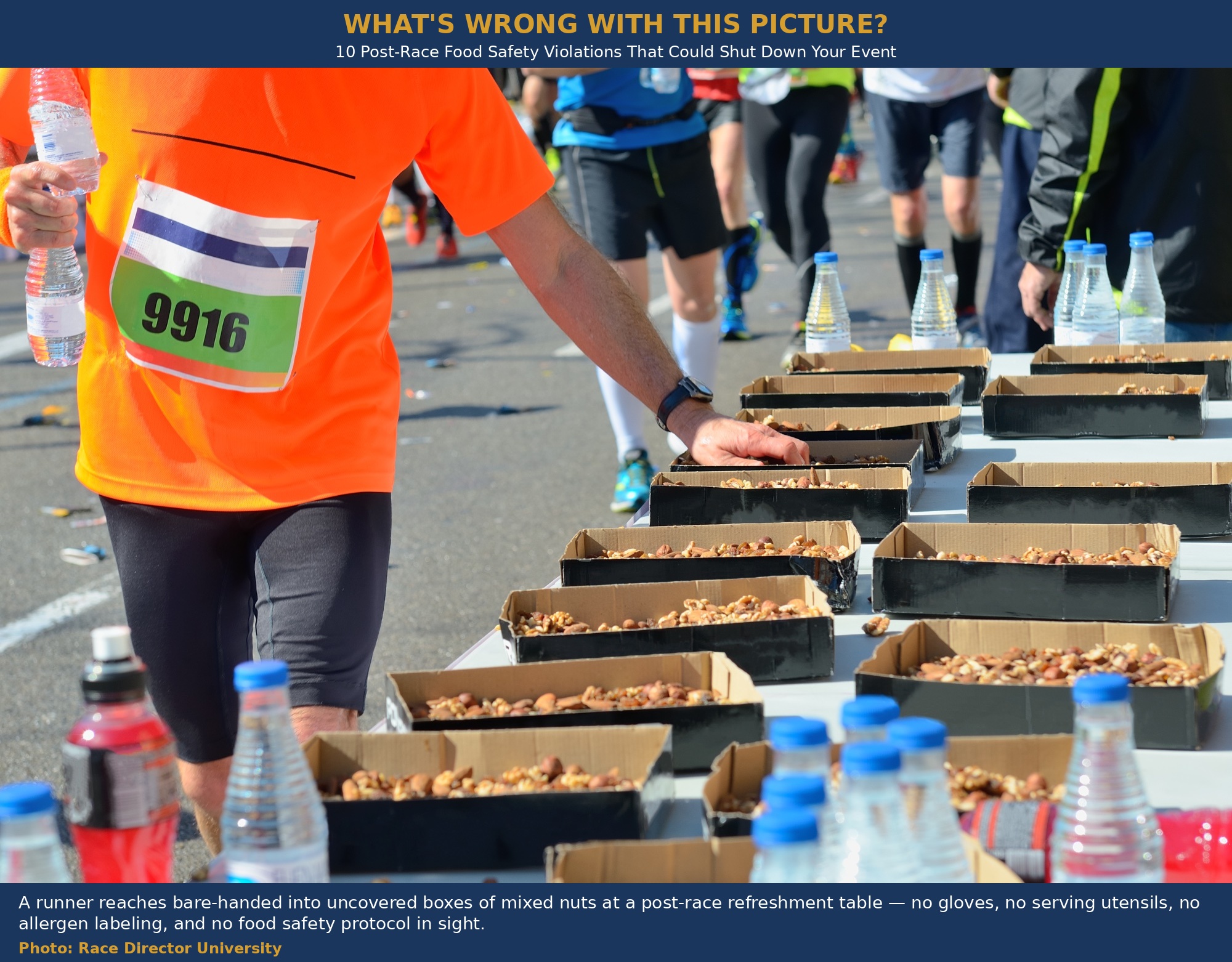
RDU Identifies the Worst Hygiene Practices by Volunteers and Event Staff Serving Post-Race RefreshmentS
DeKalb, Ill. (February 24, 2026) /ENDURANCE SPORTSWIRE/ — Race Director University (RDU) is calling attention to the most dangerous and overlooked food safety violations occurring at post-race refreshment areas across the endurance sports industry. From cut fruit sitting in the sun to ungloved volunteers handling food, these preventable hygiene failures expose race directors to serious liability and put immunocompromised finishers at risk.
“Every weekend across America, thousands of runners cross a finish line, grab a banana slice from a table that’s been sitting in 85-degree heat for four hours, and nobody thinks twice about it,” said Gregory J. Evans, Founder & CEO of Race Director University. “Cut fruit is the number one offender. The moment you slice into a melon or orange, you’ve created a TCS food — a Time/Temperature Control for Safety food — that requires refrigeration at 41°F. Most race directors don’t even know that.”
THE 10 WORST POST-RACE FOOD SAFETY VIOLATIONS
- Cut Fruit Served Without Refrigeration — Sliced oranges, watermelon, bananas, and cantaloupe become TCS foods the moment they are cut. Bacteria from the rind transfers to the flesh during cutting. The FDA requires cut melon to be held at 41°F or below. In 2011, a Listeria outbreak linked to cantaloupe resulted in 147 illnesses and 33 deaths. At most race finish lines, cut fruit sits on unrefrigerated tables for hours in direct sunlight.
- Bare-Hand Contact with Ready-to-Eat Food — Volunteers routinely handle bagels, orange slices, cookies, and energy bars without gloves. The FDA Food Code prohibits bare-hand contact with ready-to-eat food. Unwashed hands are a primary vector for norovirus, which requires only 10–10 viral particles to cause illness and is resistant to hand sanitizer.
- No Handwashing Stations for Food Volunteers — The majority of post-race food areas have zero handwashing facilities. Portable toilets without sinks do not meet health code requirements. The CDC mandates 20 seconds of soap-and-water handwashing before food handling. Hand sanitizer is not an acceptable substitute for norovirus prevention.
- Unrefrigerated Perishable Foods — Cream cheese, hummus, yogurt, chocolate, and dairy-based items donated by sponsors are routinely set out without ice or refrigeration. The USDA’s two-hour rule states that perishable food left in the temperature danger zone (41°F–135°F) for more than two hours must be discarded — reduced to one hour when temperatures exceed 90°F.
- Cross-Contamination at Shared Serving Tables — Volunteers use the same gloves (or bare hands) to handle multiple food items. Runners reach across tables, touching food they don’t take. Serving utensils are shared between items or missing entirely. One contaminated hand touching a communal food tray can expose hundreds of finishers.
- Sick and Sneezing Volunteers Handling Food and Beverages — There is no health screening for race day food volunteers. A volunteer sneezing into their bent arm and then continuing to pour water into cups is a scene that plays out at every race in America — and nobody thinks twice about it. Sick volunteers should be reassigned to non-food roles such as giving directions or managing gear check, not handling anything runners will consume. Individuals recovering within the 48-hour window following vomiting or diarrhea must be excluded from food and beverage service entirely. The 2018 PyeongChang Olympics norovirus outbreak was traced to asymptomatic food handlers.
- No Temperature Monitoring of Food or Beverages — Race directors rarely, if ever, check food temperatures at post-race areas. Without thermometers, there is no way to verify that cold items remain below 41°F or hot items above 135°F. Sports drinks and pre-poured beverages left in direct sun become bacterial breeding grounds as sugar content accelerates growth.
- Uncovered Food Exposed to Environmental Contaminants — Bagels, cookies, pretzels, and baked goods sit uncovered on tables exposed to insects, vehicle exhaust, wind-blown debris, and animal contamination. Bird and geese droppings near finish line food areas are a common and ignored biohazard at park-based events.
- Donated Food with Unknown Handling History — Local businesses and sponsors donate food for post-race hospitality with no documentation of storage, preparation, or transport conditions. Homemade items from volunteers — not prepared in a licensed commercial kitchen — violate most state and local health codes. There is often zero traceability if an outbreak investigation is required.
- No Allergen Warnings or Ingredient Labeling — Peanut butter, tree nuts, dairy, gluten, and soy are commonly present in post-race food with zero signage. A runner experiencing exercise-induced anaphylaxis combined with an unlabeled allergen exposure at the finish line is a medical emergency and a litigation certainty.
RDU QUICK REFERENCE SERIES: HOSPITALITY & POST-RACE SERVICES
These violations are addressed in detail in the RDU Quick Reference Series, a collection of 21 professional reference guides covering all aspects of endurance event management. The Hospitality & Post-Race Services guide includes job descriptions, food safety checklists, temperature monitoring logs, and volunteer training protocols. The complete 21-guide collection is available at racedirectoruniversity.com.
“If a runner collapses from heat exhaustion, every race director knows the protocol. But if 200 runners get norovirus from a contaminated food table three days later, most race directors wouldn’t even connect it to their event,” Evans said. “Food safety at the finish line is the blind spot of our industry.”
About Race Director University
Race Director University is the first national certification program for race directors in the United States, established in 2012. RDU offers three levels of professional certification, The Professional Race Director Portal monthly subscription, and the 21-guide Quick Reference Series. Founded by Gregory J. Evans, who served as Chairman of Long Distance Running for the USATF Illinois Association from 1989–2022, RDU provides the industry’s most comprehensive professional development resources for endurance event management.
###
Media Contact:
Gregory J. Evans
Founder & CEO, Race Director University
greg@racedirectoruniversity.com
Company Info
Race Director University
CONTACT INFO
Race Director University
630.327.1619
greg@racedirectoruniversity.com
http://racedirectoruniversity.com
Follow us on